
AEO vs SEO: What’s the Difference and Why It Matters in 2026
The way people search for information is changing.
As a digital marketer, I’ve been paying close attention to how search is becoming more conversational and answer-focused. People are not only typing keywords into search engines anymore. They are also asking complete questions and using AI-powered search experiences to find quick and useful answers.
This is where AEO (Answer Engine Optimization) is becoming increasingly important.
But one question comes up often:
AEO vs SEO — what is the difference?
And more importantly, does AEO replace SEO?
The short answer is no.
SEO and AEO have different focuses, but they can work together to create a stronger digital marketing strategy. In this blog, I’ll explain what SEO and AEO mean, how they differ, and how businesses and website owners can prepare their content for the changing search landscape.
What Is SEO?
SEO stands for Search Engine Optimization.
SEO is the process of improving a website and its content so that search engines can better understand it and show it to people searching for relevant information.
SEO has been an important part of digital marketing for many years. When I work on SEO, I look beyond just adding keywords to a page. A good SEO strategy can involve several areas, including:
- Keyword research
- On-page optimization
- Technical SEO
- Content creation
- Internal linking
- Website speed
- Mobile optimization
- Image optimization
- Link building
- Local SEO
For example, if someone searches for “digital marketing expert in Malappuram,” a properly optimized website has a better opportunity to appear for that relevant search.
SEO is not simply about ranking a page. It is about making a website useful, accessible, understandable, and relevant to its target audience.
What Is AEO?
AEO stands for Answer Engine Optimization.
AEO focuses on creating and structuring content so that it can provide clear and useful answers to users’ questions in answer-focused search experiences.
Think about how you naturally ask a question.
Instead of searching only:
“AEO vs SEO”
a user might ask:
“What is the difference between AEO and SEO?”
Or:
“Is AEO replacing SEO?”
Or:
“How can I optimize my website for AEO?”
AEO focuses strongly on these types of questions and user intent.
The goal is to make your content easy to understand and useful when someone is looking for a direct answer.
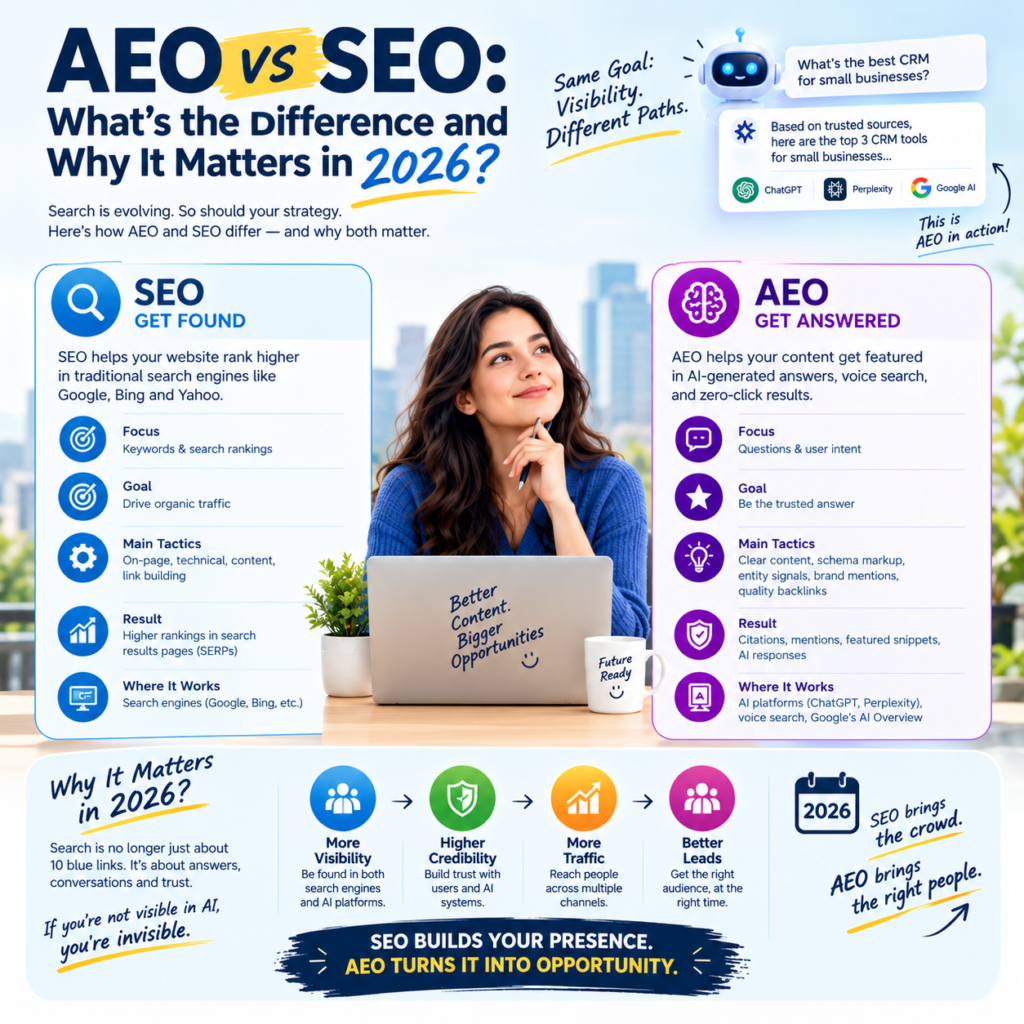
AEO vs SEO: The Main Difference
The simplest way I explain the difference is:
SEO focuses strongly on improving visibility in search results, while AEO focuses on making content useful for answer-based search experiences.
Here’s a simple comparison:
SEO
| Search Engine Optimization |
| Focuses on search visibility and rankings |
| Targets keywords and search intent |
| Helps attract organic traffic |
| Uses technical and content optimization |
| Traditional search remains a major focus |
AEO
| Answer Engine Optimization |
| Focuses on providing useful answers |
| Targets questions and conversational intent |
| Helps content become more answer-ready |
| Emphasizes clear, direct and structured answers |
| AI and answer-focused search experiences are an important focus |
However, this doesn’t mean that SEO and AEO are completely separate.
There is a lot of overlap between them.
Why Is AEO Becoming Important?
Search behavior is becoming more conversational.
People want answers quickly, and they increasingly phrase searches as questions.
For example, a traditional search might be:
“SEO services Malappuram”
A conversational search could be:
“How can a small business improve its Google visibility?”
These searches have different wording, but they can have a similar underlying goal: finding useful digital marketing information.
This is why I believe content creators and businesses should start thinking beyond individual keywords.
Instead, ask:
What questions does my audience have?
What information are they looking for?
Can my content provide a clear and trustworthy answer?
This approach can make content more useful for both people and modern search experiences.
Is AEO Replacing SEO?
No.
This is one of the biggest misunderstandings around AEO.
I don’t see AEO as a replacement for SEO. Instead, I see it as an extension of a broader search visibility strategy.
SEO still matters because websites need strong foundations.
You still need:
- Search-friendly website structure
- Relevant content
- Good technical performance
- Internal links
- Useful pages
- Relevant keywords
- Quality user experience
At the same time, AEO encourages us to make content more direct, conversational, and focused on answering real questions.
So rather than thinking:
SEO vs AEO
I prefer thinking:
SEO + AEO
How SEO and AEO Work Together
A strong content strategy can use both approaches.
For example, imagine I am creating an article about digital marketing for small businesses.
From an SEO perspective, I might research keywords related to:
- Digital marketing
- SEO
- Social media marketing
- Website design
- Google Ads
From an AEO perspective, I might also identify questions such as:
- What is digital marketing?
- Why is SEO important for small businesses?
- How can social media help a business?
- How long does SEO take?
- What is the difference between SEO and AEO?
Now the article is not only targeting keywords. It is also answering the questions that potential customers may actually ask.
That is where the combination becomes powerful.
7 Ways to Make Your Content More AEO-Friendly
1. Answer Questions Clearly
Start by identifying questions your audience is asking.
When answering a question, don’t make the reader search through several paragraphs to find the answer.
Give a clear answer first and then provide more explanation.
2. Use Question-Based Headings
Instead of using vague headings, use headings that reflect what people want to know.
For example:
What is AEO?
How is AEO different from SEO?
Is AEO replacing SEO?
How can businesses optimize for AEO?
This makes the content easier to navigate.
3. Understand Search Intent
Keywords are important, but keywords alone are not enough.
I always recommend asking what the person behind the search actually wants.
Someone searching “AEO strategy” may want an explanation.
Someone searching “how to implement AEO” may want practical steps.
Understanding this difference helps you create more relevant content.
4. Keep Answers Simple and Direct
Not every answer needs to be complicated.
For informational content, clear language is often more useful than unnecessary technical terms.
Try to answer the question directly and then expand with examples, explanations, or steps.
5. Create FAQ Sections
FAQ sections can be a useful way to address common questions from your audience.
For example, an article about SEO could answer:
What is SEO?
Why is SEO important?
How long does SEO take?
What is AEO?
Is AEO better than SEO?
These questions can also help you discover new content ideas.
6. Structure Your Content Properly
Good content structure helps readers understand your article.
I recommend using:
- H1 for the main title
- H2 for major sections
- H3 for supporting sections
- Short paragraphs
- Bullet points
- Tables where useful
- FAQs
- Clear introductions and conclusions
A well-organized article is easier for users to read and easier for search systems to interpret.
7. Focus on Helpful, Original Content
Optimization should never come before usefulness.
Instead of creating content only to target keywords, create something that genuinely helps your audience.
Share your experience, explain concepts clearly, use practical examples, and keep information updated.
For a personal portfolio like mine, this is especially important because my content should demonstrate what I know and how I think as a digital marketer.
A Simple AEO + SEO Workflow
If you’re starting from scratch, you don’t need an overly complicated strategy.
Here is the process I would follow:
Step 1 — Find your topic
Choose a topic relevant to your audience and business.
Step 2 — Research keywords
Find the keywords people use when searching for that topic.
Step 3 — Find related questions
Think about the questions your audience might ask about the topic.
Step 4 — Understand search intent
Determine whether users want information, comparisons, instructions, or a solution.
Step 5 — Create useful content
Write content that answers the main question and covers important related questions.
Step 6 — Optimize the page
Apply relevant SEO best practices, including headings, internal links, title tags, meta descriptions, and technical optimization.
Step 7 — Make answers easy to find
Use clear sections, concise explanations, FAQs, lists, and tables where appropriate.
Step 8 — Keep improving
Search behavior changes, so content should be reviewed and updated when necessary.
AEO vs SEO: Which One Should You Focus On?
If you’re a business owner, blogger, freelancer, or digital marketer, you don’t necessarily need to choose one.
I would recommend building a solid SEO foundation first and then incorporating AEO principles into your content strategy.
Think of it this way:
SEO helps your website become discoverable.
AEO helps your content become answer-focused.
Using both allows you to create content that is designed around what people search for and what they actually want to know.
The Future of Search
Digital marketing is constantly changing.
The strategies that worked several years ago may not be enough on their own today. Search is becoming more conversational, and users are expecting faster and more useful answers.
For me, this is one of the most interesting parts of digital marketing.
AEO is not about abandoning everything we know about SEO. It is about adapting our content strategy to changing user behavior.
The fundamentals still matter:
Understand your audience.
Create useful content.
Build a strong website.
Answer real questions.
Keep learning and adapting.
Frequently Asked Questions About AEO vs SEO
What is the difference between AEO and SEO?
SEO focuses on improving a website’s visibility in search engines, while AEO focuses on creating content that clearly answers users’ questions in answer-focused search experiences.
Is AEO replacing SEO?
No. AEO and SEO complement each other. SEO provides an important foundation, while AEO adds a stronger focus on direct answers and conversational search intent.
Is AEO important in 2026?
Yes. As search becomes more conversational and AI-powered, understanding how to create clear, useful, answer-focused content is increasingly valuable.
Does AEO help Google rankings?
AEO should not be viewed as a guaranteed ranking technique. Many AEO practices overlap with good content and SEO practices, such as answering questions clearly, organizing information well, and focusing on user intent.
How do I start AEO for my website?
Start by identifying the questions your audience asks. Create clear answers, use descriptive headings, structure your content properly, and combine these practices with your existing SEO strategy.
Should I use SEO or AEO for my business?
You can use both. A strong SEO foundation combined with an answer-focused content strategy can help your website adapt to different search behaviors.
My Final Take on AEO vs SEO
As a digital marketer, I don’t think the future is about choosing between SEO and AEO.
It’s about understanding how people search and what they expect from the content they find.
SEO remains an important part of building online visibility. At the same time, AEO encourages us to create content that answers questions clearly and provides genuine value.
For me, the best approach is simple:
Don’t just create content to rank. Create content that helps people.
When we understand our audience, answer their questions, and build a strong SEO foundation, we can create a website that is more useful, more relevant, and better prepared for the future of search.
Explore more Nusaiba E Digital Marketing Expert in Malappuram
Table of Contents
Toggle